AI’s role in content and commercial production has steadily expanded over the last decade. Brands of all sizes are now experimenting with AI tools such as Google Veo 3, which have made full-motion commercial content possible at a fraction of traditional costs. Experts predict that in just a few years, AI could be responsible for generating the majority, if not all, advertising content. Whether that prediction is true or completely off depends on many factors.
Whether you embrace or approach it with caution, AI’s move into the mainstream exposes some emotional blind spots and challenges in how AI-driven content is perceived. This article draws on some of the key tenets of the Think Blink Manifesto. It explores how brands can harness AI’s capabilities without losing the human leadership that gives content meaning. We also discuss where AI should be used with caution or perhaps not at all.
Can You Maintain Emotional Authenticity in the Age of AI?
The term “AI slop” has emerged online to describe the overwhelming increase in AI-generated content that feels cheap, inauthentic, or emotionally flat. As marketers experiment with AI, speed and volume over quality are major issues. Transparency is also a concern. As audiences encounter more content that feels misleading, generic, or “off,” their skepticism grows towards both AI-generated content and the brands behind it.
AI-generated content must be intentional and thought out. Unfortunately, many brands are rushing in without a plan. This kind of reactive behavior is being encouraged by AI companies that need their products to become profitable. Marketers need to tune out the hype and develop a plan to determine whether AI content is right for their brand, and, if so, how to use it effectively without breaking trust with consumers.
Here are several principles brands should keep in mind when using AI to produce content:
Define the Emotional Truth Before Using AI
The ThinkBlink Manifesto explains that understanding your audience’s emotional and cognitive needs is primary. Human insight should guide AI, not the other way around. The first step is to clearly define the emotional truth you want to convey before engaging any AI tool. Manage emotion as a strategic input, not something you ask AI to add later.
That being said, AI is clumsy when it comes to human context. It can’t really grasp why something is funny to one person and not to another, for example. Even complex, thorough prompting doesn’t always result in emotional connection.
Last year, Coca-Cola released a series of AI-generated Christmas ads that received a lot of criticism. In spite of using similar themes and images to past ads, distorted shapes and unnatural movements made these AI-ads feel off. The visuals, especially those of people, offered little emotional depth. Instead of unfolding as a narrative, the film felt technical and assembled, like a display of AI rather than a well-thought-out story. While the brand deserves credit for exploring AI’s potential, this case illustrates how compelling emotional stories remain uniquely human.
Protect Distinctive Brand Voice
AI naturally defaults to predictable, average language. An authentic voice depends on identity and cultural context, things that are difficult for AI to replicate easily. Creating guidelines for tone and vocabulary is a simple step brands can take – but human editing is still key. And when it comes to content creation, ideas generated by AI will also be predictable. Breakthrough content needs human creativity.
Dollar Shave Club’s recent AI-generated commercial, “We Put Our Money Where it Matters”, provides a compelling example. It depicts a fictional CEO who chooses AI over real people, resulting in absurd visuals such as a shaving gorilla. Rather than trying to hide the use of AI, the brand makes it part of the joke. It also positions itself as part of the conversation around AI skepticism. Currently, some of the most successful AI-generated content provides commentary on AI by making fun of it.
Image Source: Dollar Shave Club Official YouTube
Test Emotion, Not Just Performance
The Think Blink Manifesto underlines the importance of measuring emotional connection. AI is powerful at processing vast volumes of data to identify sentiment trends. In theory, this provides clarity on what emotions are growing in specific audiences on certain themes. But AI can’t grasp why this change is happening or how brands should use it to drive storytelling. AI can process the data and may provide confident advice on what to do with it, but humans will have a better understanding of the nuances at play.
Still, strategic measures must include emotional filters. This can involve A/B testing to determine whether a line of copy or visual genuinely resonates, or a follow-up evaluation to understand what people remember. Or it can be more complex qualitative research using biometric sentiment analysis that provides the richest data. Gathering the data becomes easier with AI.
One caveat to watch for: as AI content becomes easier to create and harder to detect, online content, especially on social media, is increasingly bot-driven. Total internet traffic is now more than 50% automation. Social media platforms aren’t transparent about how much content and engagement is bot-driven, so sentiment monitoring will need to shift to more reliable means.
Transparency, Always
A big no-no is trying to pass off AI-generated content as real. Consumers’ trust is in a free-fall across all industries, and transparency is a key issue driving this problem. When you use it, make sure it’s clearly labelled as AI-generated.
When Not to Use AI
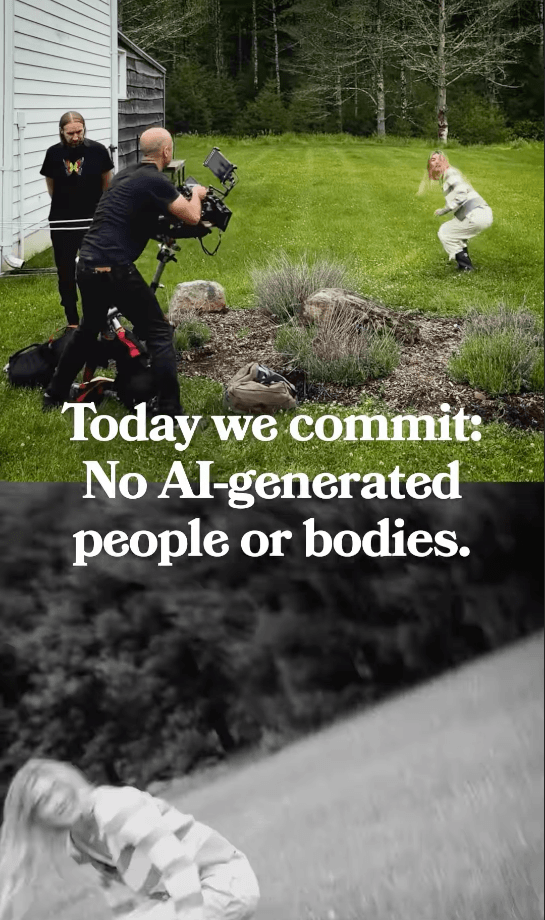
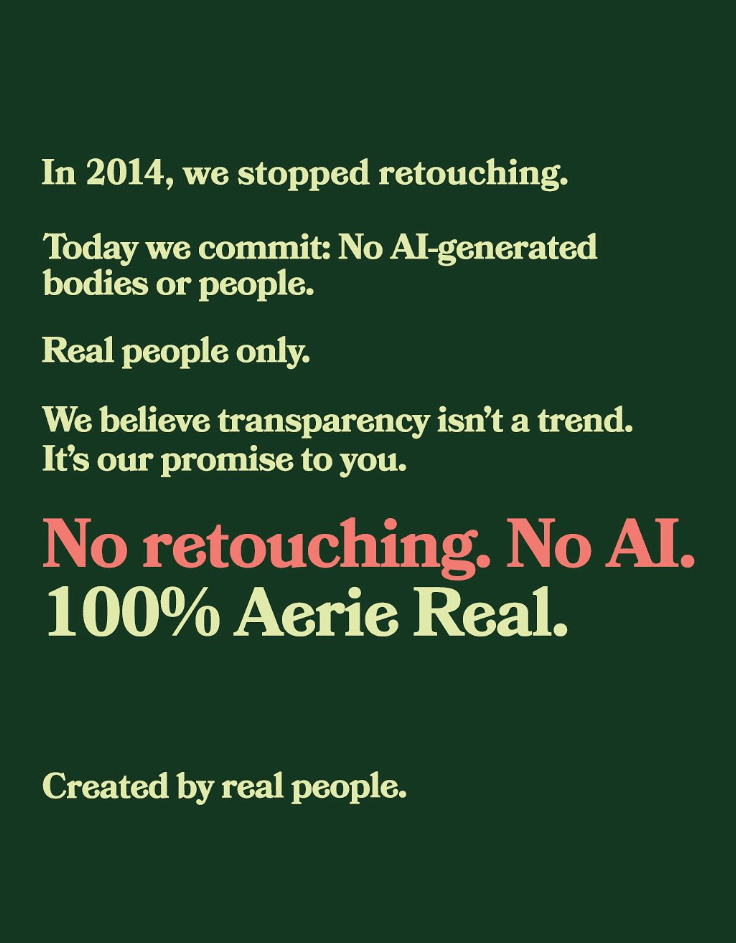
Aerie has publicly declared they will not use AI-generated content in its marketing content as a promise to consumers. This makes sense: Aerie has built its brand on real beauty, including untouched photography and models of all ages, shapes, sizes, ethnicities, and abilities. This comes back to understanding the human context, one of the core tenets of the ThinkBlink Manifesto. If your consumer wants to know they’re seeing real people, violating that would be foolish.
Brands need to keep their finger on the pulse of their customer as AI evolves. Attitudes toward AI are shifting rapidly and must be monitored in real time. Marketers tend to be first adopters and are more tech-forward than the average consumer – many are in denial about the potential for AI backlash. Forcing AI content on consumers who don’t want it only elevates this risk.
Image Source: Aerie Official Instagram
As generative tools become more accessible and more convincing, using them without a clear emotional foundation and alignment to your consumer is a real risk. The Think Blink Manifesto reinforces that emotional connection can be supported by technology, but is fundamentally human. Brands that succeed will be those that use AI power for efficient execution, guided by people who define the meaning and intent.