
Your brand’s reputation does a great deal of heavy lifting: it draws in and retains loyal consumers while paving a path to long-term success. Unfortunately, brand reputation is also the most fragile asset your brand owns. As Warren Buffet put it, “it takes 20 years to build a reputation and five minutes to ruin it.” How to overcome negative brand perceptions is an important lesson all brand leaders need to understand.
Why is brand reputation so vulnerable? Negativity bias is a key driver, as negative situations will be remembered “more strongly and in more detail” than positive situations. These negative situations also take longer to “wear off,” so brands will feel the shockwaves well after impact. Add to the record numbers of people unemployed and a great deal of social and economic uncertainty, and you have an emotionally heightened market place in which communication paramount.
Thankfully, there are methods to address all negative perception scenarios, ranging from quickly nipping issues in the bud, to handling full-scale crises. Below we discuss three scenarios and how they may be applicable to your brand.
Scenario One: Proactive Perception Management
Things are good. The consumer is happy, revenues are strong, and there is nothing but blue skies ahead. Now, this is a state of mind that can be dangerous to fall into, as it is easy to become blindsided once stagnation or disruption occurs and brands are out of touch or unable to pivot quickly. Companies that have been successful with brand perception consistently research and revisit their consumers to ensure that they can remain on the same page. The importance is to align how the public perceives your brand and how you want them to perceive your brand.
Here are a number of tips to maintain a positive perception and consistently understand your consumer:
- Regularly conduct customer satisfaction surveys to remain on top of their feedback.
- Actively leverage customer testimonials in communications to encourage peer influence and exude an authentic tone.
- Monitor your brand by reviewing Search Engine Result Pages (SERP) and using Google Autocomplete, giving you the ability to proactively address any up-and-coming problems.
Scenario Two: Issue Management
Things are precarious. A negative issue has occurred, and it may only be a matter of time before it gains traction and causes an impact to the brand. Perhaps you committed a gaff in response to COVID-19 that was perceived to be inappropriate or insensitive.
In this case, Melissa Agnes has developed a detailed flowchart, which you can see below. This is a great template to provide frontline staff with the tools they need to evaluate their next steps in the case of a negative event. It outlines when to monitor and wait, when to respond, and at which point the situation requires escalation to crisis.
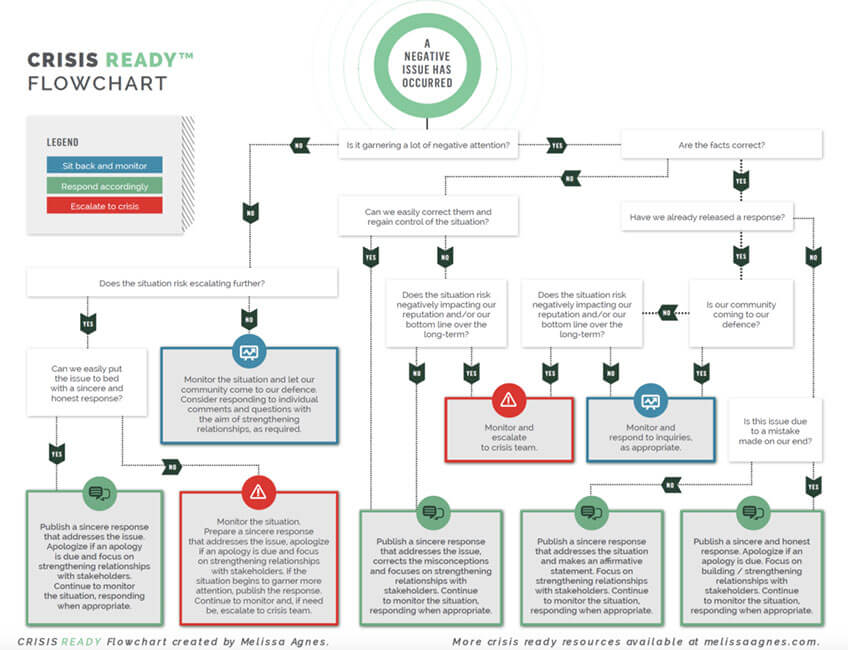
With this model in mind, the key takeaways of issue management are to:
- Quickly engage with complaints on social media in a genuine manner, taking it offline whenever possible.
- Allow your community to come to your defense when applicable, making an official comment if the issue progresses.
- Address all issues with sincerity and honesty, and if an apology is due then be proactive and make one.
- Focus on the strengthening of relationships with stakeholders with any formal statement, regardless of if your brand is at fault.
- Continue to monitor the situation closely after resolution to ensure it does not re-escalate.
Now, if the negative situation does not quietly deescalate, the next scenario is relevant.
Scenario Three: Crisis Management
Things are bad. The negative impact is severe enough to be reflected in the brand’s long-term reputation and bottom line. A recent example that fits this category would be CrossFit CEO Greg Glassman’s controversial comments about demonstrations in response to the death of George Floyd.
This is where it’s best to execute with the following best-in-class framework for crisis communication. Through a comprehensive research study with over 34 experiments and 3,500 participants in the US and Germany, the results determined the strongest communication strategies for a range of crisis situations.
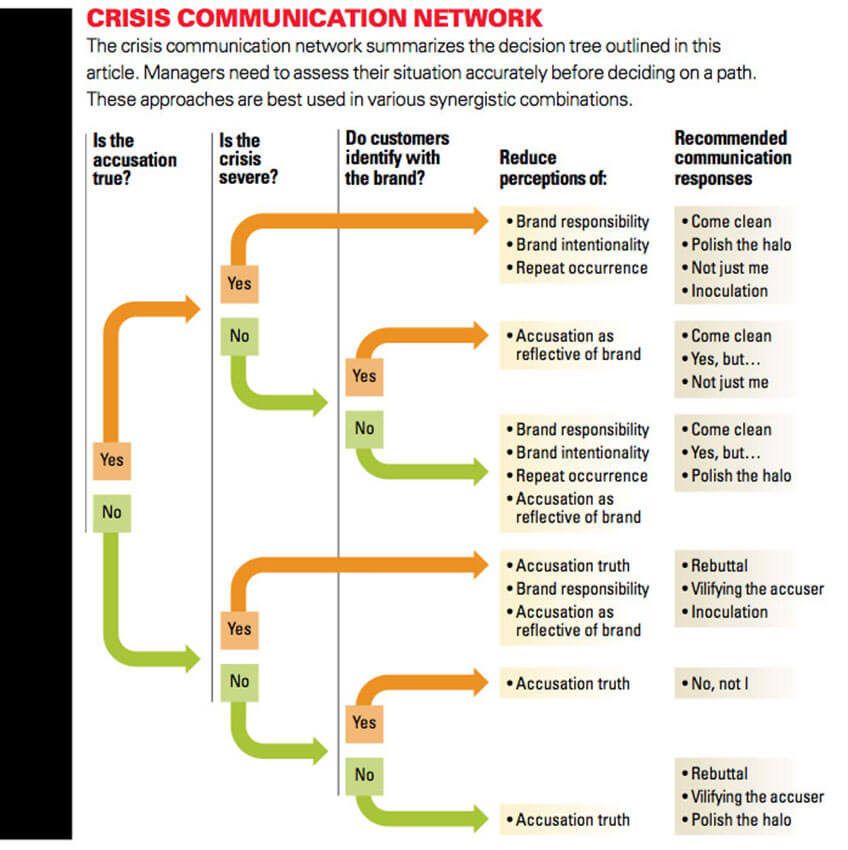
The recommended communication responses can be summarized as following:
If the accusation is true:
- Come Clean: Apologize, accept responsibility, discuss prevention, take corrective action (if required). In the case of CrossFit, Glassman resigned within days.
- Polish the Halo: The “come clean” response followed by an image-building campaign showcasing the brand’s strengths. An example of this is The PepsiCo Foundation’s water initiatives following severe backlash in India.
- Not Just Me: Supply clues to guide customers towards a narrative to relieve your brand of sole responsibility.
- Yes, But…: Explain your stance and downplay the damages. This is only applicable when the crisis is not severe.
If the accusation is false:
- No, Not I: Deny and construct a narrative to prove innocence. An example of this is Tommy Hilfiger’s fabricated racism scandal. This began with a viral email in 1996 stating that Tommy Hilfiger was a guest on The Oprah Winfrey show, confirmed racist statements, and was then told to leave. The contents of this email were false, as Hilfiger had never been on the show, let alone made the racist remarks. Tommy Hilfiger repeatedly denied the claims and Oprah Winfrey made an announcement on her show that the email was fabricated. A dozen years later, Tommy Hilfiger went on the Oprah Winfrey show to confirm – again – that no such thing happened, with Winfrey telling her audience “it’s a big, fat lie!” to drive home the narrative.
- Rebuttal: A point-by-point rebuttal to all the accusations.
- Inoculation: Anticipate questions and prepare counterarguments, be aggressive in defense. This is particularly important in the case of high media coverage.
All these scenarios are relevant to your brand. A proper plan to monitor and communicate with consumers is key, and giving your frontline staff the tools to do so will equip you with preparedness for any scenario.